8. Casting Deciding Votes in case of a tie in the board's voting:
9. Performing Other Duties as Required by Law or company regulations
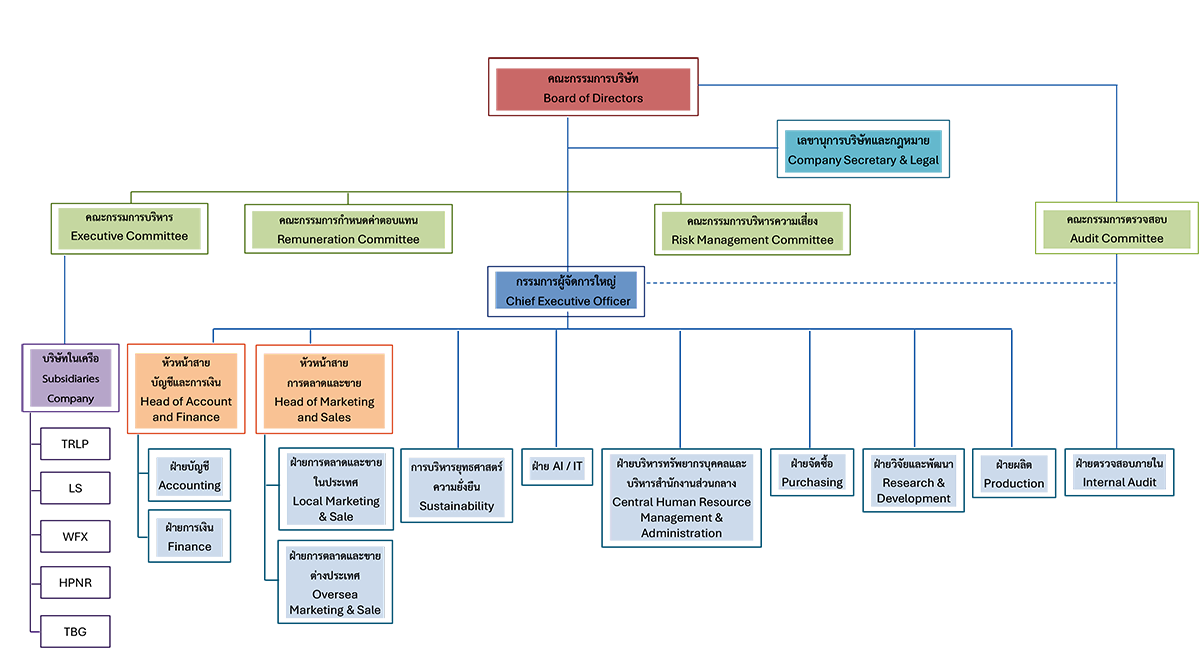
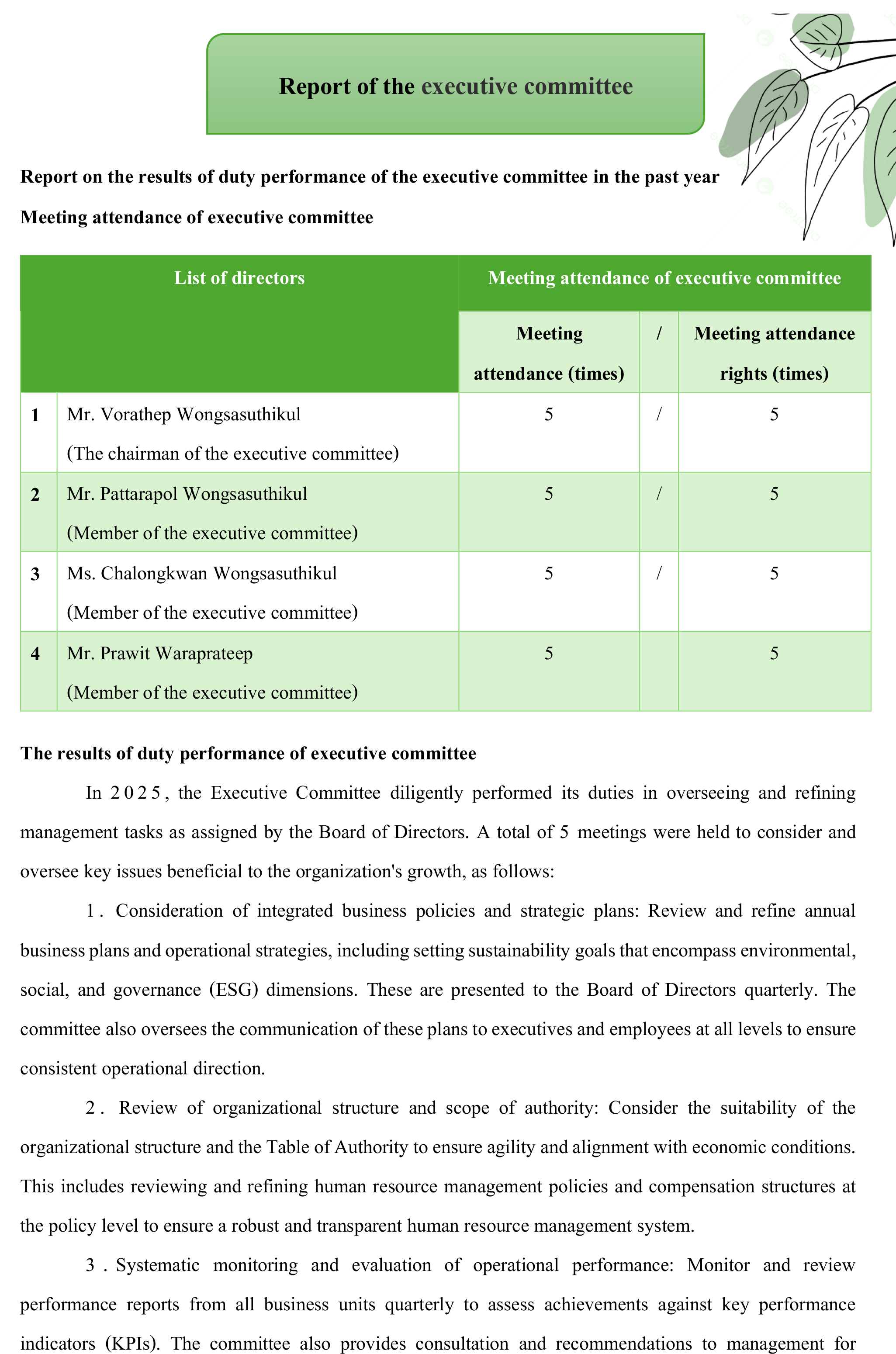
Scope of authorities, role, and duties of Executive Committee
The company has established work regulations and operational authorities as a framework for management according to its duties, as follows:
1. Consider and determine annual goals, policies, plans, and budget allocations as proposed by management, before submitting them to the Board of Directors for approval. This includes considering and approving changes and additions to the annual expenditure budget during periods when there is no Board of Directors meeting, and presenting them to the Board of Directors for acknowledgment at the next meeting.
2. Require executives of various departments responsible for operations in different businesses to report their performance to the Executive Committee monthly.
3. Approve expenditures in accordance with established company regulations.
4. Approve capital expenditures as specified in the annual budget, or as approved by the Board of Directors in the annual budget, or as approved in principle by the Board of Directors.
5. Approve in principle investments in business expansion, as well as joint ventures with other operators, and present them to the Board of Directors for approval at the next meeting.
6. Approve the appointment of authorized signatories for company checks or payment documents.
7. Serve as an advisory committee to management on policies related to production, marketing, finance, human resources, and other operational matters.
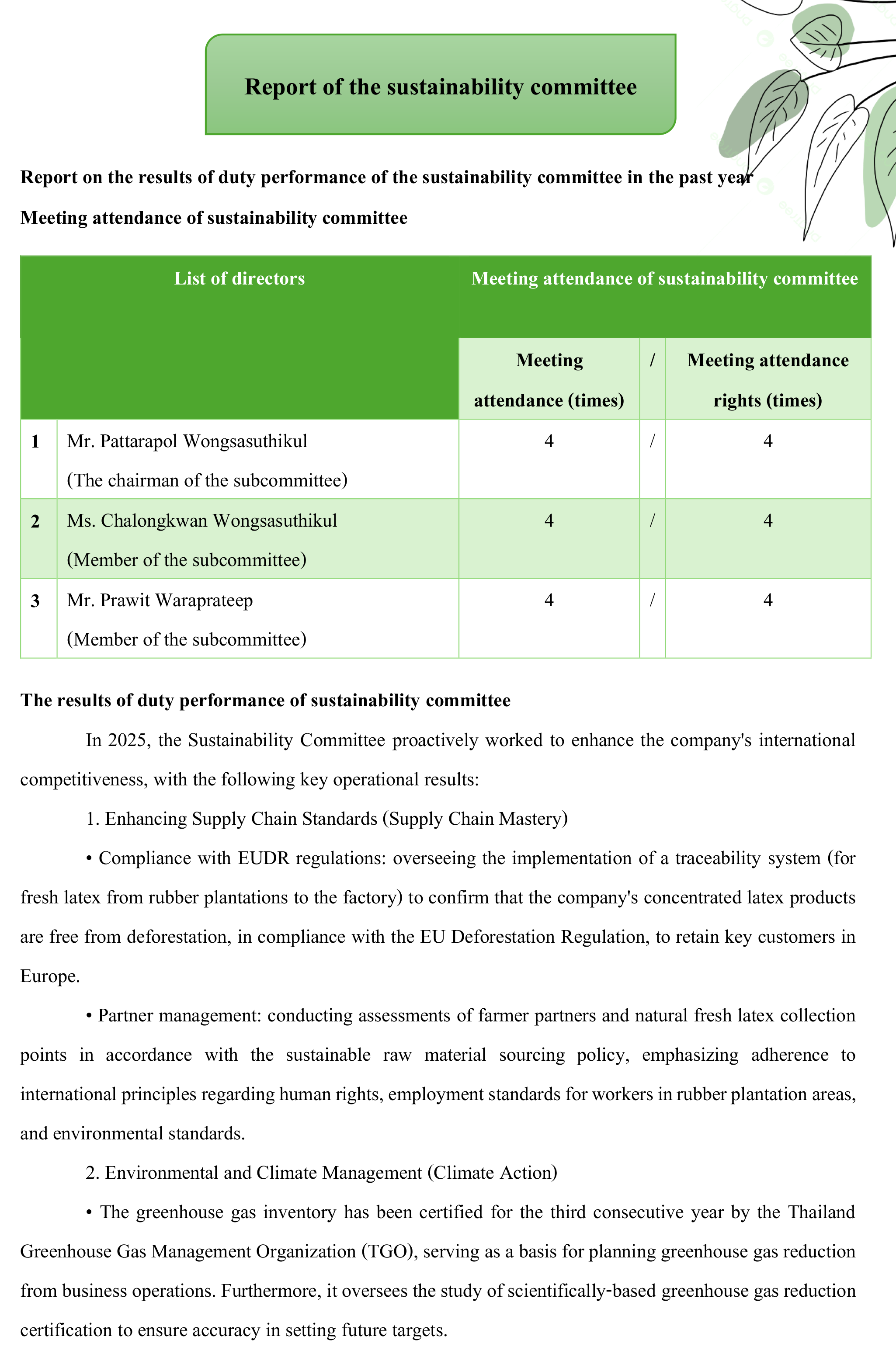
8. Oversee corporate sustainability development and the management of impacts, risks, or opportunities arising from climate change.
9. Approve the appointment, transfer, and termination of employees.
10. Perform any other duties as assigned by the Board of Directors.
Roles and Duties of Chief Executive Officer
- Formulate policies, visions, objectives, strategies, business plans, and annual budgets of the Company and its subsidiaries for submission to the Executive Committee and/or the Board of Directors for further approval.
- Supervise, manage, operate, and perform routine business operations for the benefit of the Company in accordance with the vision, business direction, policies, business strategies, goals, operational plans, and annual budgets approved by the Executive Committee and/or the Board of Directors and/or as assigned by the Executive Committee and/or the Board of Directors.
- Coordination with the Audit Committee to ensure that the Company's business operations, including risk management, are in accordance with the Company's objectives and requirements, as well as the resolutions of the Executive Committee and/or the Board of Directors and/or the resolutions of the shareholders' meeting.
- Approval of entering into any contracts and/or transactions related to the normal course of business of the Company (e.g., trading, investing, or jointly investing with other persons for the purpose of carrying out the normal course of business of the Company and for the benefit of the Company's operations in accordance with its objectives) within the conditions and limits specified in the Delegation of Authority and/or as determined by the Executive Committee and/or the Board of Directors and/or in accordance with relevant laws and regulations and/or the Company's Articles of Association.
- Approval of any borrowing of loans, approval of borrowing, and application for any credit facilities from financial institutions, lending, as well as pledging, mortgaging, or acting as a guarantor of the Company and its subsidiaries, within the conditions and limits specified in the Delegation of Authority or as determined by the Executive Committee and/or the Board of Directors.
- Monitor, inspect, and control the operations of the Company, subsidiaries, and/or joint ventures to ensure good performance in accordance with targets and report to the Executive Committee and the Board of Directors every quarter, including seeking opportunities to improve and develop better performance.
- Develop the organization to have good operating results and performance, and continuously improve and develop to enable the organization to grow sustainably.
- Investment management in new projects, ensuring that the study of investment opportunities in good new projects is carried out by conducting appropriate and comprehensive technical and financial studies to support decision-making.
- Manage the development of corporate sustainability in the environmental, social, and governance (ESG) aspects, including the management of impacts, risks, or opportunities from climate change.
- Asset reporting management, carrying out related reporting and reporting on the acquisition and disposal of assets, including the Company's regulations, as approved by the Executive Committee meeting and/or the Board of Directors meeting and/or the shareholders' meeting, in accordance with the relevant regulations.
- Consider the criteria for selecting executives, consider the criteria and methods for recruiting and selecting persons to hold senior management positions in conjunction with the Remuneration Committee.
- Appointment of various advisors necessary for the Company's operations within the conditions and limits specified in the Delegation of Authority and/or as determined by the Executive Committee and/or the Board of Directors.
- Establish rules, regulations, guidelines, practices, and requirements for the organizational structure in positions below the Managing Director, including the hiring, appointment, transfer, dismissal, and termination of employees of the Company in positions below the Managing Director.
- Formulate policies, compensation structures, formats, and guidelines for employee compensation in conjunction with the Executive Committee and submit them to the Remuneration Committee for consideration and approval before submitting them to the Board of Directors for further approval.
- Consider employee compensation in accordance with the compensation structure policy approved by the Board of Directors and submit it to the Executive Committee for further approval.
- Issuing orders, regulations, announcements, and various memorandums within the Company to ensure that the Company's operations are in accordance with policies and for the benefit of the Company, including maintaining discipline within the organization, authorizing and/or sub-delegating any person or persons to perform any act on behalf of the Managing Director, within the scope of authority specified in the Company's power of attorney and/or the regulations, rules, or resolutions of the Board of Directors. The delegation of authority, duties, and responsibilities of the Managing Director shall not be in the nature of a delegation or sub-delegation that would enable the Managing Director or the person authorized by the Managing Director to approve transactions in which he or she or a person who may have a conflict of interest (as defined in the notifications of the Securities and Exchange Commission and/or the Capital Market Supervisory Board) may have an interest or may benefit in any way or may have any other conflict of interest with the Company or its subsidiaries, except for the approval of transactions that are in accordance with the policies and criteria approved by the Board of Directors.
- To perform other duties as assigned by the Executive Committee and/or the Board of Directors, including having the authority to take any actions necessary to carry out such duties.
Roles, Duties, and Responsibilities of the Company Secretary
The Company Secretary is a position required by law for companies listed on the Stock Exchange, in accordance with the Securities and Exchange Act and the criteria of the Office of the Securities and Exchange Commission (SEC). The primary role is to support the Board of Directors and the organization in operating legally and in compliance with Good Governance principles and Good Corporate Governance practices and company regulations, while maintaining independence and preventing conflicts of interest. The key roles are as follows:
1. Documentation and Information Management
Prepare and maintain key documents, such as the Register of Directors, meeting notices, and minutes of the Board of Directors and Shareholders' meetings. Prepare the Annual Information Disclosure / Annual Report (Form 56-1 One Report). Maintain conflict of interest reports submitted by directors and executives; organize filing systems for easy tracking; coordinate with directors and executives to certify reports and ensure information is updated regularly.
2. Supporting the Board of Directors and Sub-committees
- Organize Board and Shareholders' meetings in compliance with laws and company regulations; prepare agendas; oversee the delivery of meeting notices and supporting documents within the legal timeframe; record minutes and track the implementation of resolutions; plan the meeting calendar and ensure meetings proceed smoothly and in accordance with the company's articles of association.
- Oversee electronic meetings (E-Meetings) to ensure compliance with relevant regulations (e.g., the Emergency Decree on Electronic Meetings, B.E. 2563).
- Provide preliminary advice to the Board regarding the Public Limited Companies Act, SET/SEC regulations, and company articles of association that directors must be aware of and adhere to; and to monitor and report regulatory changes to the Board consistently.
- Organize orientation for new directors and prepare useful information and documents for their transition into the role.
- Coordinate with the Thailand Securities Depository Co., Ltd. (TSD) as the securities registrar to manage the shareholder list and book closing.
3. Corporate Governance
- Ensure accurate, complete, and timely disclosure of information as required by regulators (e.g., Form 56-1 One Report).
- Foster and promote company operations in accordance with Corporate Governance principles.
- Foster a culture of Good Corporate Governance and business ethics within the organization; coordinate and promote Corporate Sustainability Reporting (ESG).
- Prepare and summarize Board self-assessment results (both as a group and individually).
- Prevent insider trading and the misuse of inside information; notify and remind directors/executives regarding "Blackout Periods" for trading securities and the reporting of securities holdings (Form 59).
- Prepare or review the Corporate Governance Manual and Code of Conduct to ensure they remain up-to-date.
4. Communication
- Coordinate to ensure the effective transmission of Board policies to management for practical implementation.
- Act as a channel for communication and relationship-building with shareholders, including safeguarding shareholder rights.
- Act as the primary contact person for external regulatory agencies, such as the SEC, the Stock Exchange of Thailand (SET), and the Department of Business Development (DBD), Ministry of Commerce, regarding director registration changes and statutory filings under the Public Limited Companies Act.
Key Qualifications of the Company Secretary
- Bachelor’s degree or higher in Law, Accounting, Business Administration, Economics, or a related field.
- Completion of Company Secretary training programs, such as the Company Secretary Program (CSP) by the Thai Institute of Directors (IOD) or courses by the Thai Company Secretary Association (ASCO).
- Knowledge of corporate law and SET/SEC regulations.
- Understanding of the business and organizational management structure.
- Excellent communication, coordination, and confidentiality skills.
- Must perform duties with honesty, integrity, and prudence, while maintaining independence in expressing opinions.
- High attention to detail, especially in drafting minutes and legal documents.
- Commitment to continuous professional development, including regular attendance at training sessions or seminars organized by the SEC and SET to keep abreast of new regulations and information.