



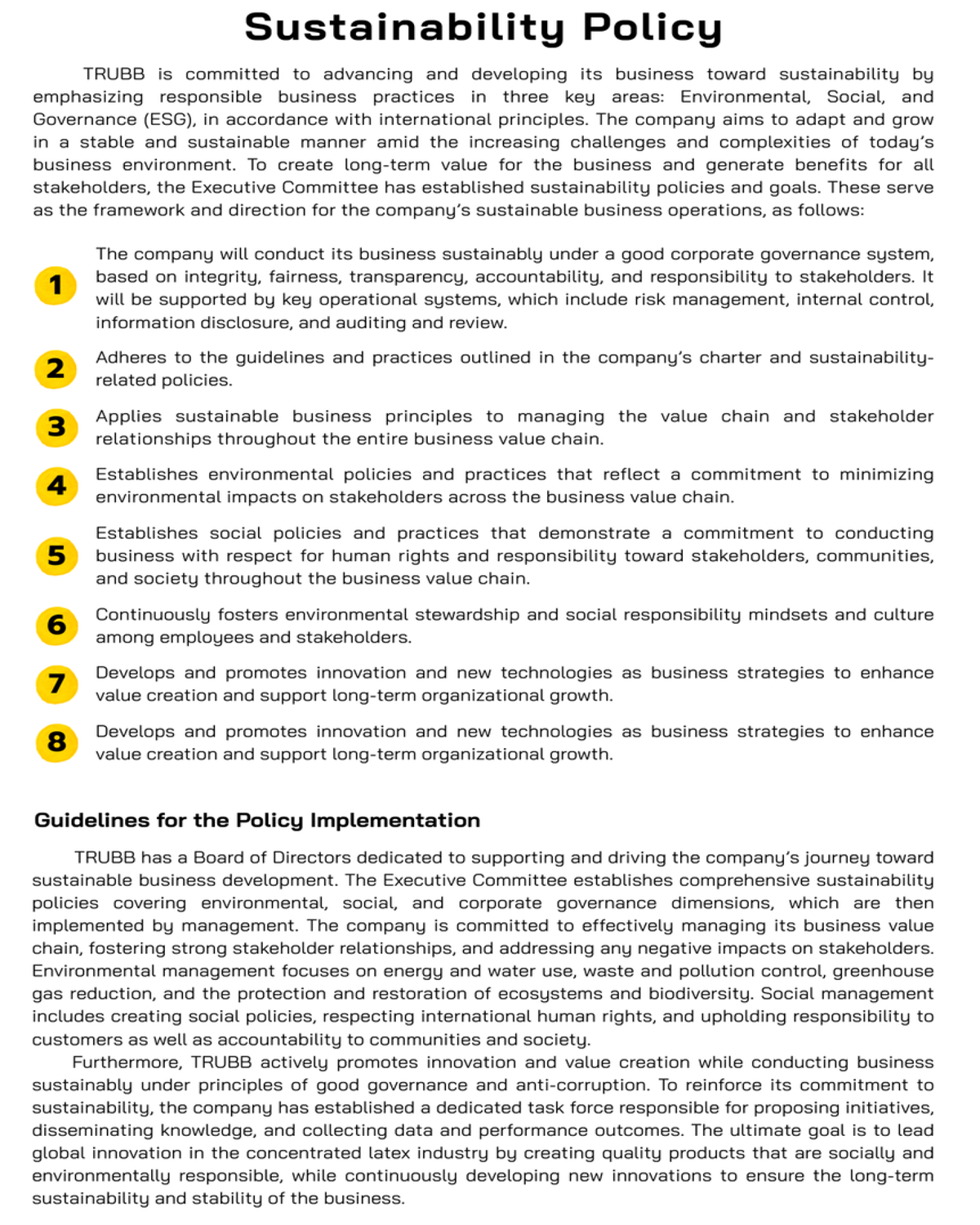
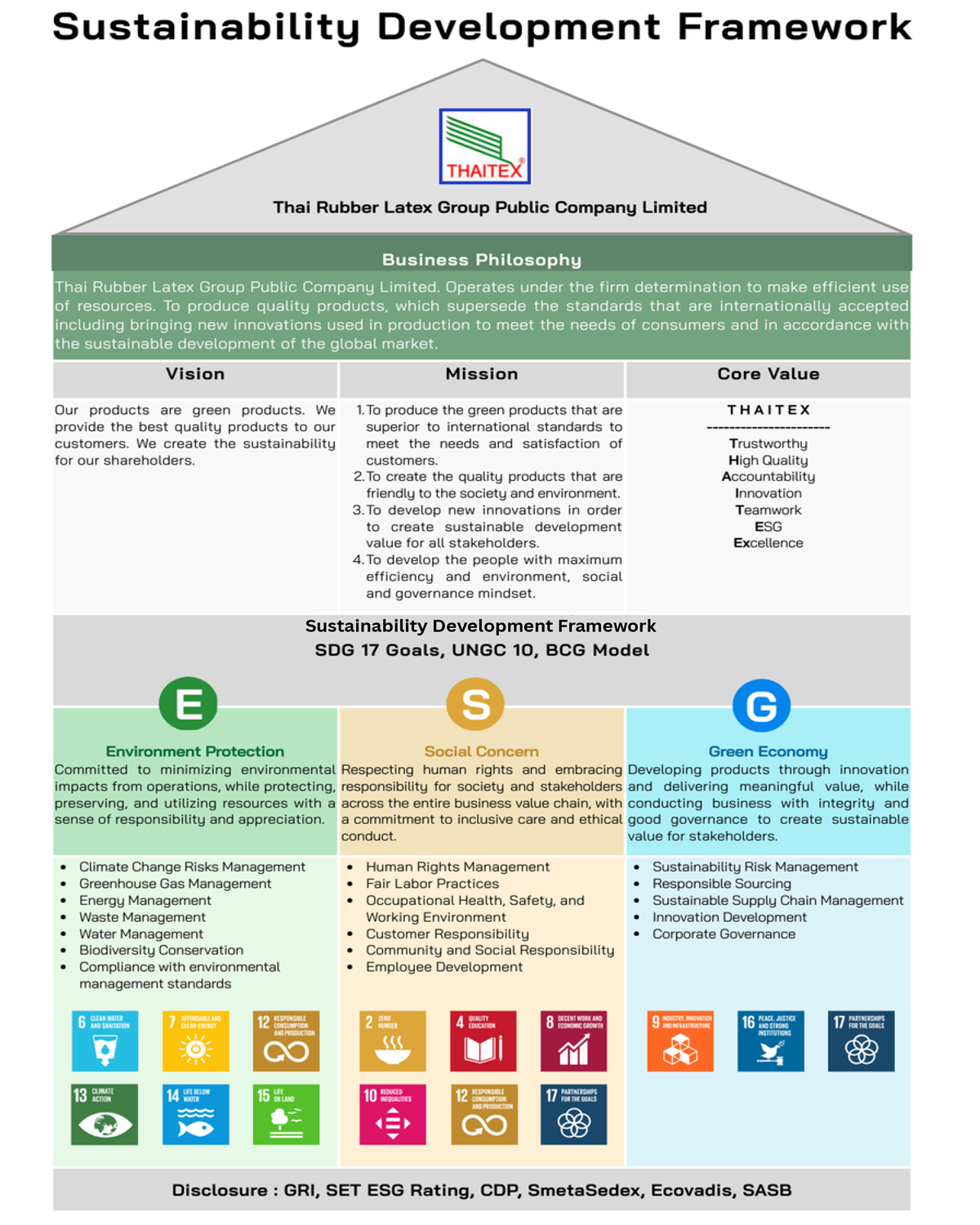
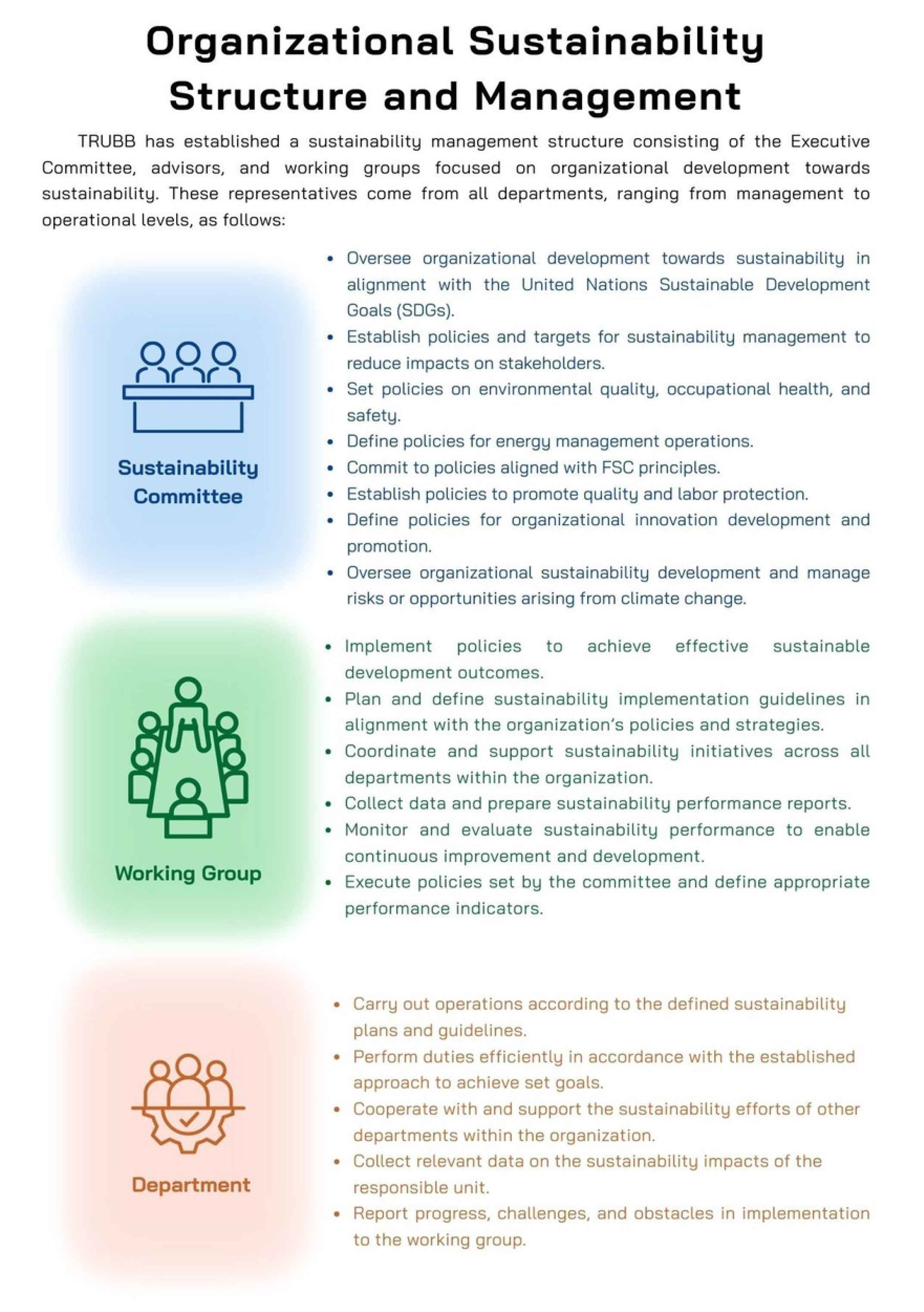
Appointment of Sustainability Committee
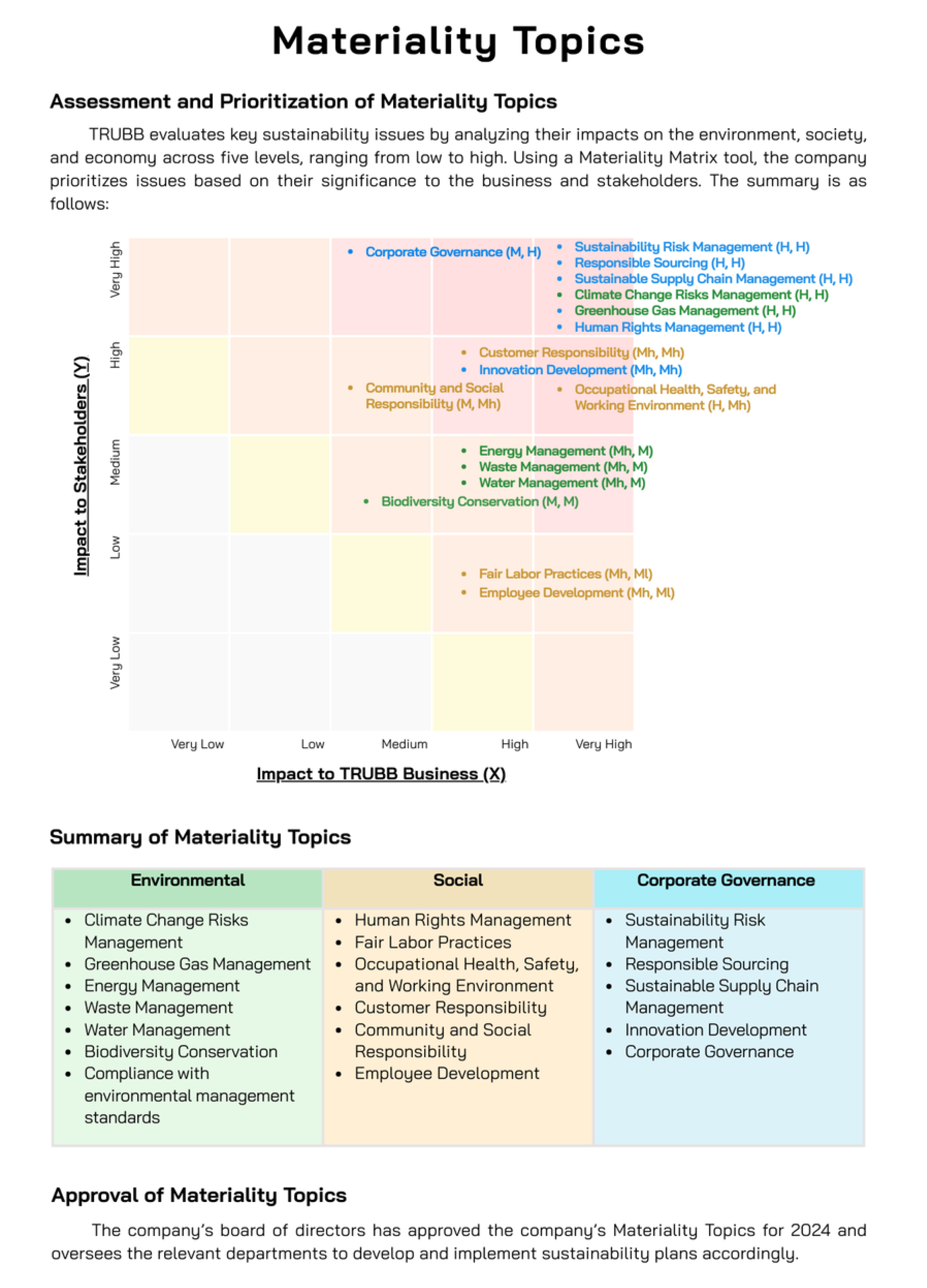
The Board of Directors has always prioritized compliance with good corporate governance principles and has foreseen the significance of running a business along with social and environmental responsibilities. Therefore, it was resolved to appoint the Sustainability Committee to be responsible for considering and setting policies and guidelines related to sustainable development, leading to a transparent and fair organizational management system to build stakeholders’ confidence in order to add value and promote the company’s competitiveness for sustainable growth as follows:
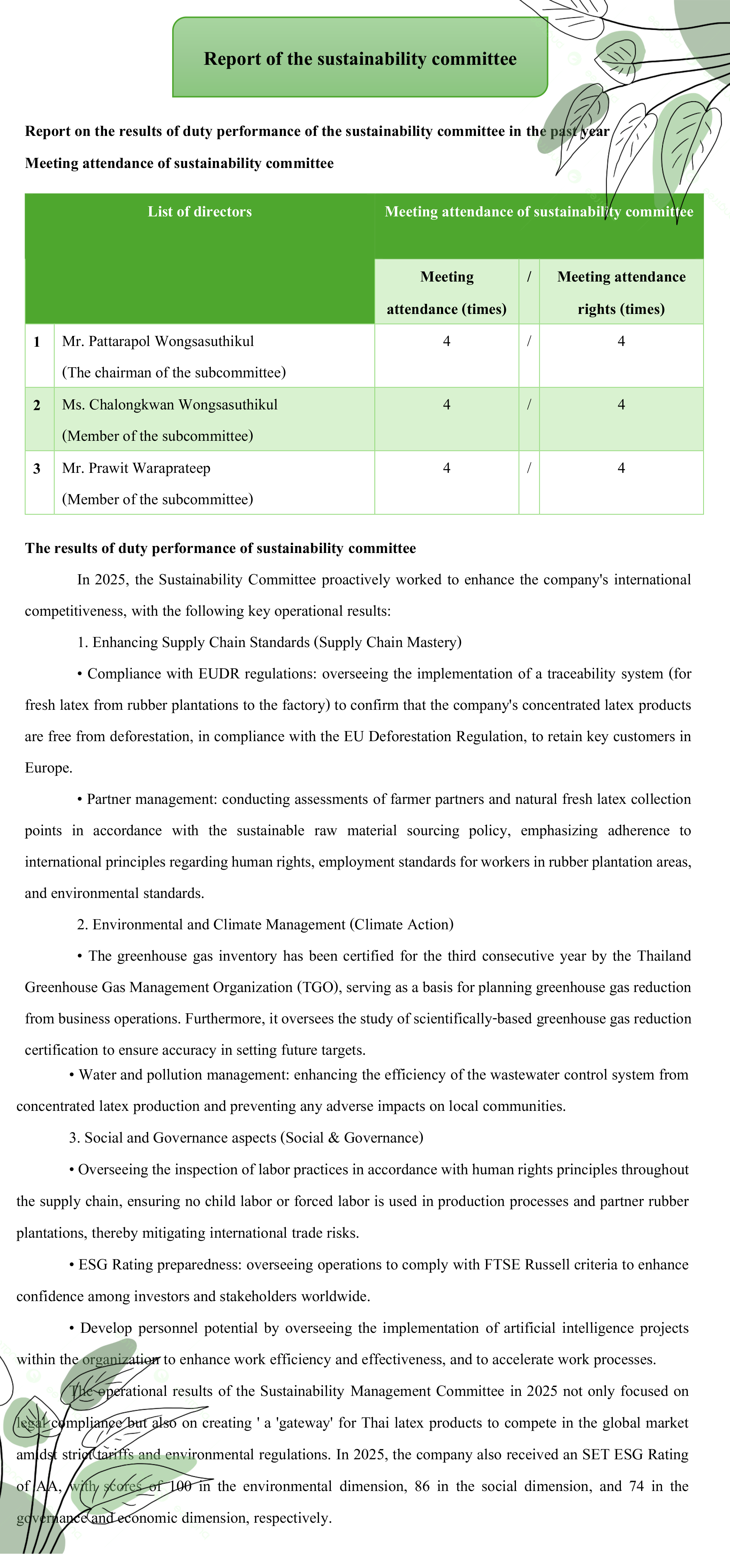
- Mr. Pattarapol Wongsasuthikul Chairman
- Mr. Prawit Waraprateep Director
- Ms. Chalongkwan Wongsasuthikul Director
Duties and Responsibilities
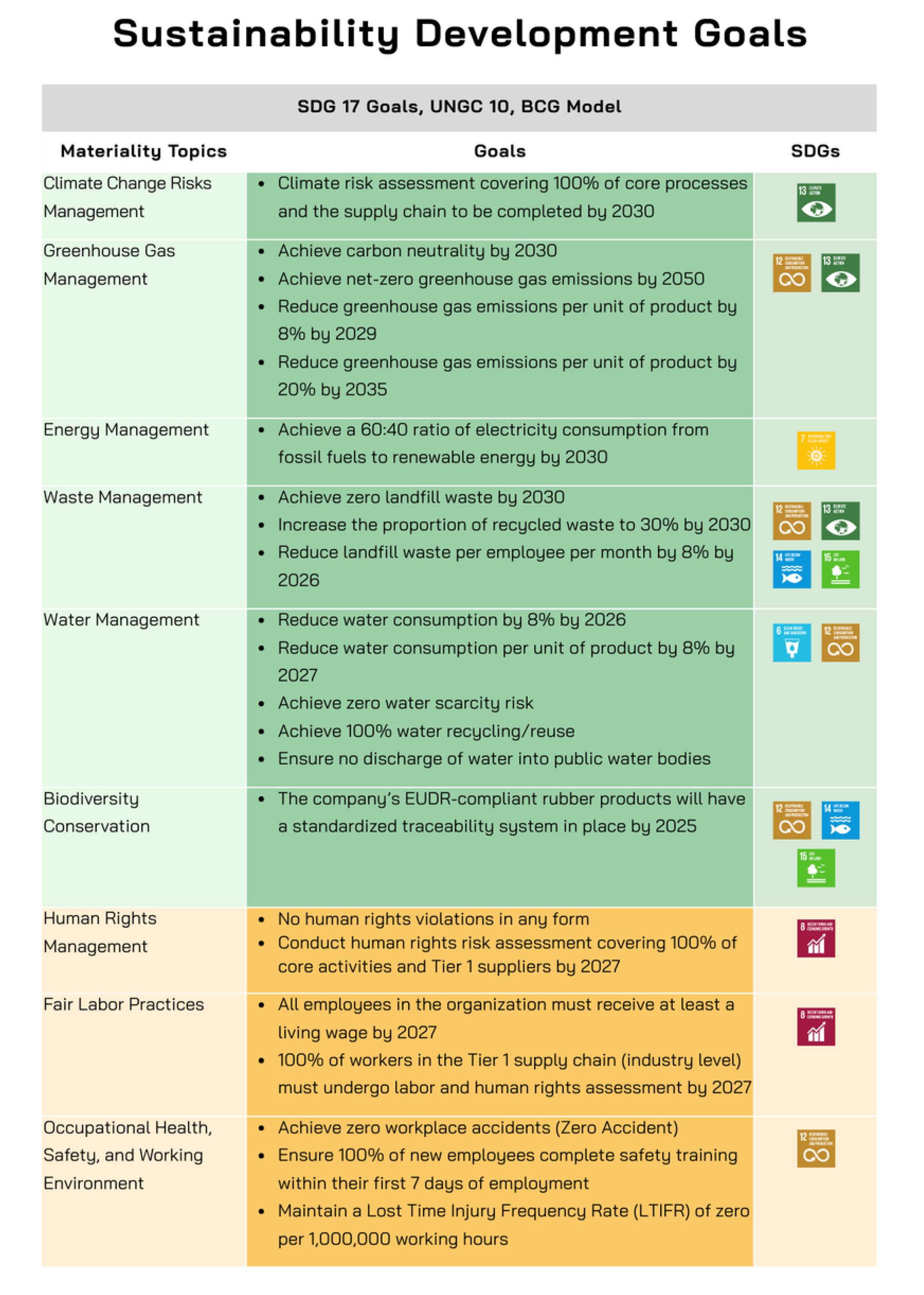
- To determine directions, policies, strategies, goals, and plans for sustainable development covering Environmental and Social dimensions and Government of the company to present to the Board of Directors.
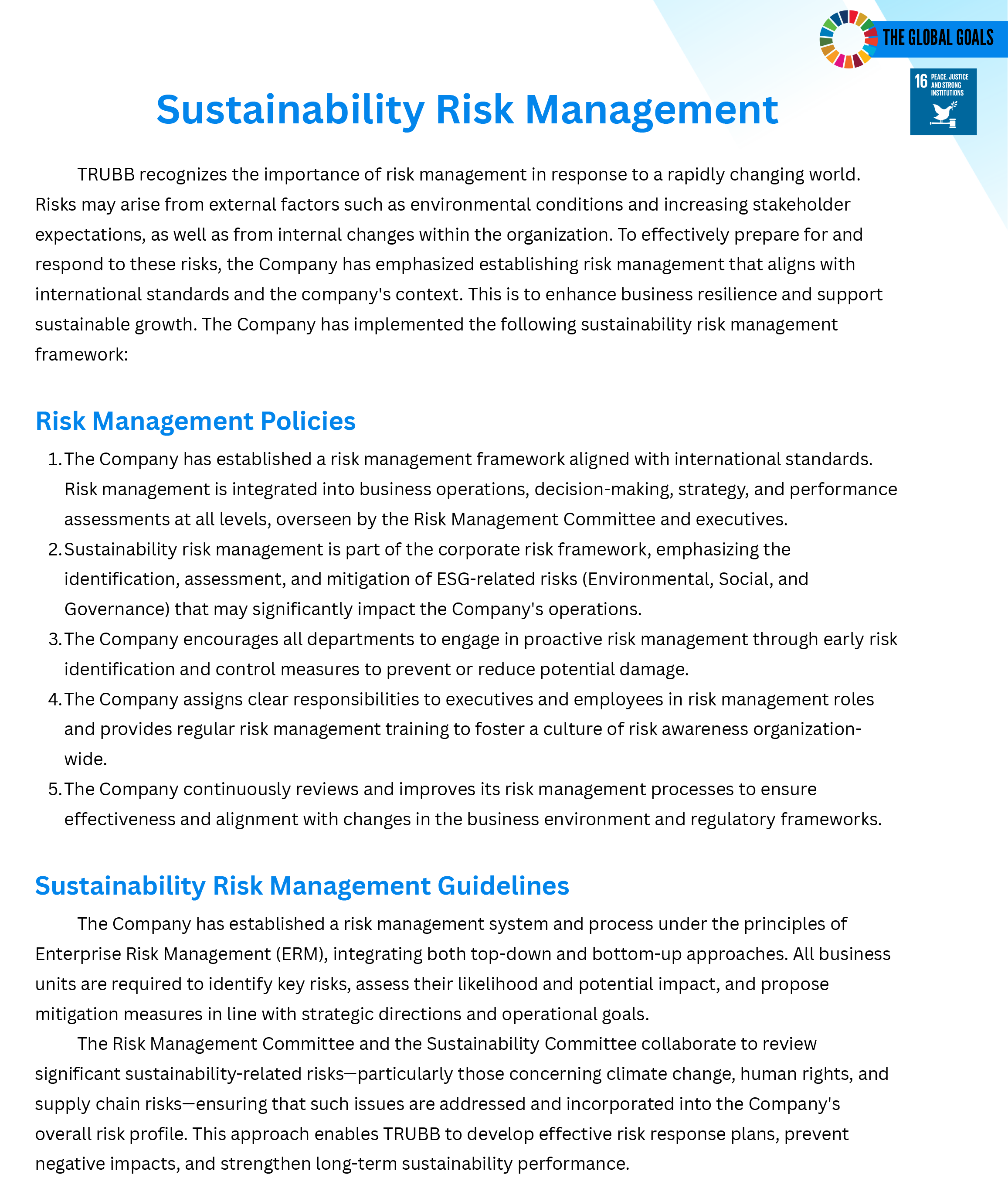
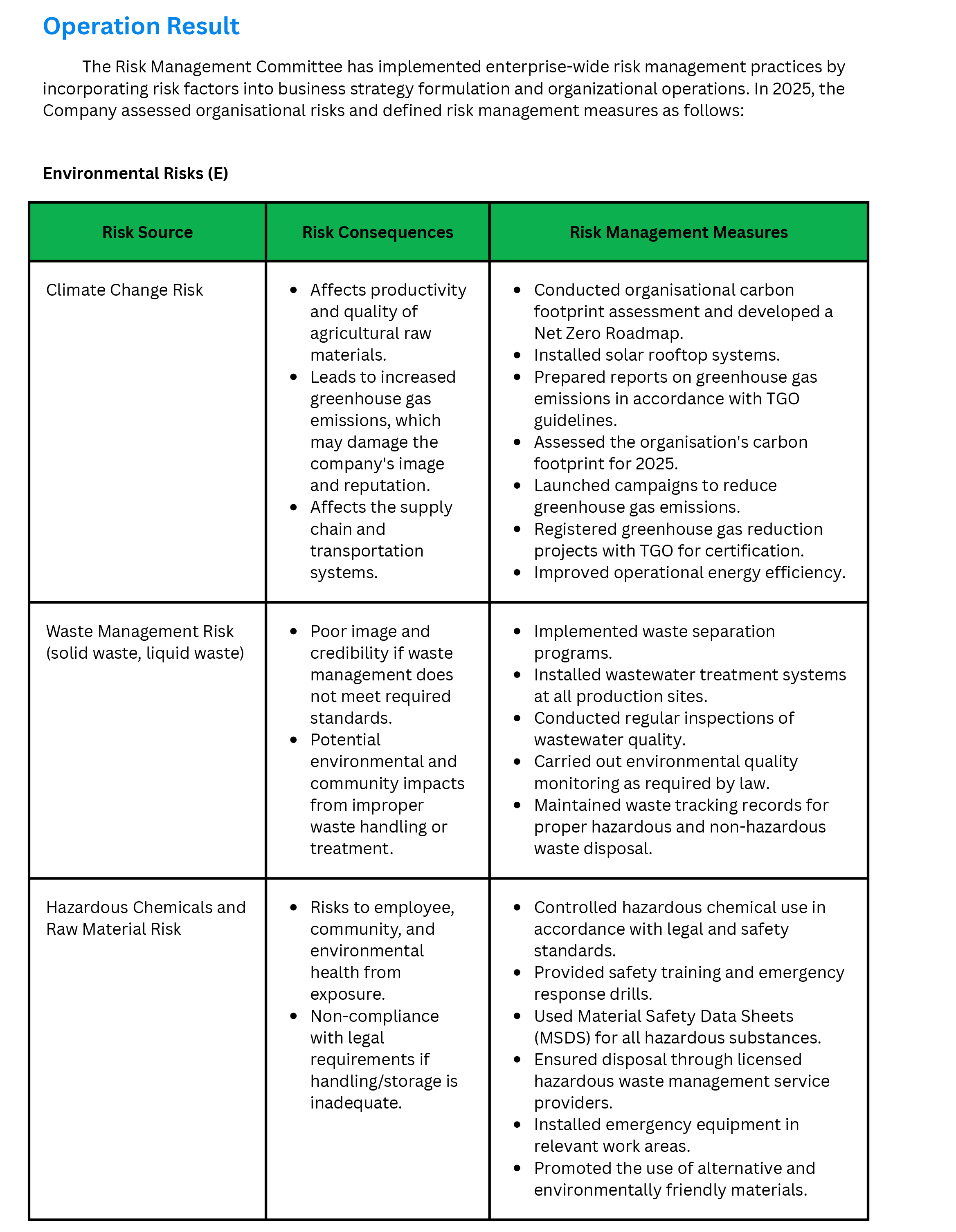
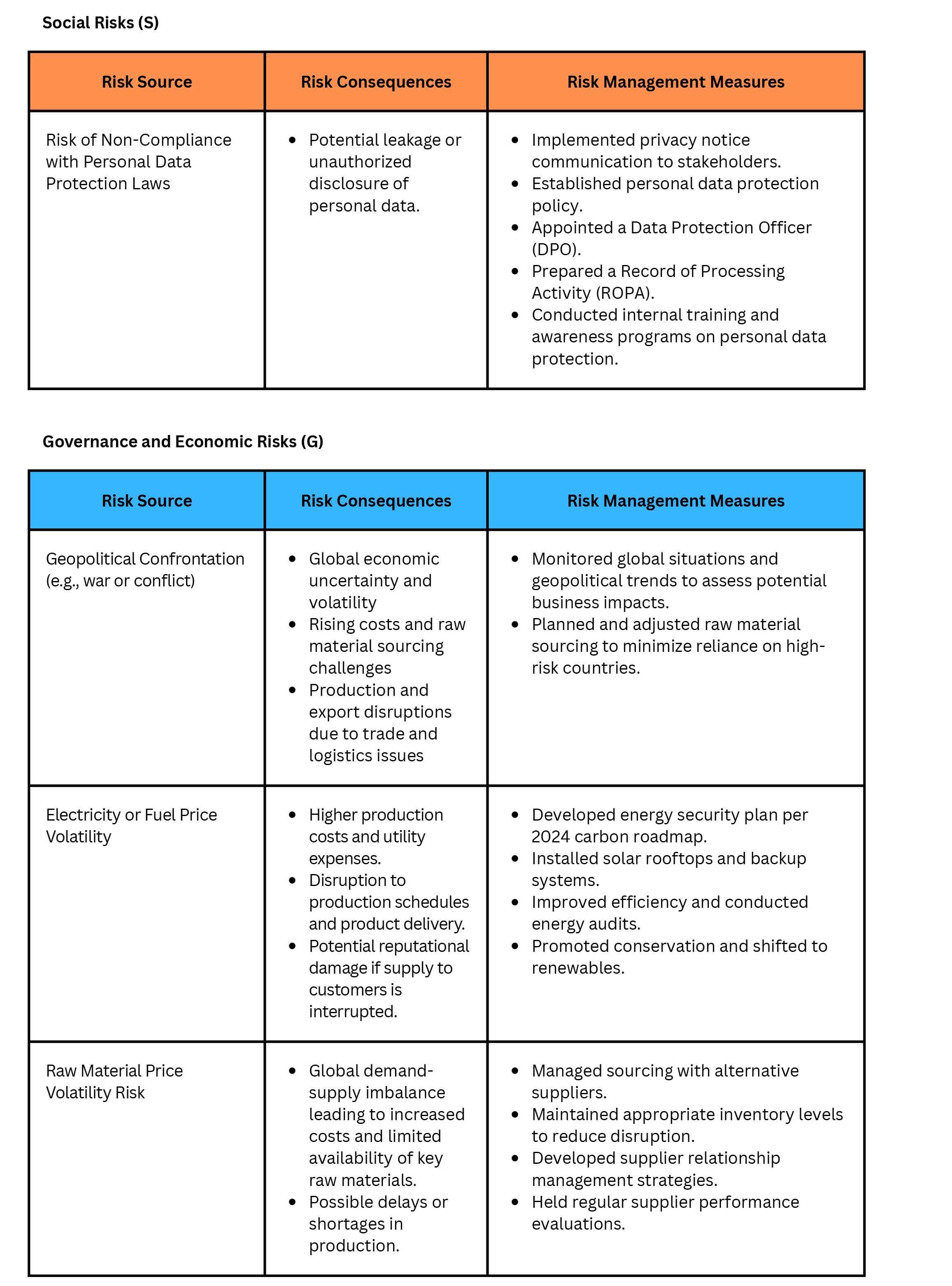
- To support and drive collaboration in sustainability performance across the organization by providing advice and promoting the integration of sustainability into business strategies, risk assessments, and short-term and long-term corporate plans in order to achieve the established corporate sustainability goals.
- To review and recommend the company’s sustainability practices in line with Best Practices and international standards by always keeping them up-to-date, and present them to the Board of Directors for further improvement and development.
- To consider and approve the company’s annual sustainability issues in line with the needs and expectations of the stakeholders, the external context, direction, and goals of the organization, and propose to the Board of Directors to seek approval and assign the management to respond and follow up.
- To follow up, summarize organization sustainability performance, and report progress to the Board of Directors at least once a year.
- To supervise the disclosure of the company’s sustainability information through the annual report and the company’s annual sustainability report.
- To consider appointing a sustainability working group as deemed appropriate.
 .
.
2025


Originally, by 2025,
there were no cases of ethical and moral misconduct within the organization.
there were no cases of ethical and moral misconduct within the organization.





Director Knowledge Development
Policy
The Board of Directors is responsible for supervising, overseeing, and establishing a development plan for all board members and sub-committees. This ensures that the Board of Directors, senior executives, and the Company Secretary consistently enhance their skills, knowledge, and capabilities, particularly whenever there are changes in laws, rules, or regulations related to business operations. Additionally, an orientation program for new directors is provided, focusing on ensuring that directors fulfill their duties in accordance with the organization’s objectives and goals to achieve maximum corporate benefit. The development plan is established as follows:
Practice Guidelines
The Board of Directors
The Board of Directors, the Nomination and Remuneration Committee, the Audit Committee, the Risk Management Committee, and the Executive Committee should regularly attend training courses or seminars beneficial to their duties regarding laws, rules, or regulations. These programs may be organized by the Thai Institute of Directors (IOD), the Securities and Exchange Commission (SEC), the Stock Exchange of Thailand (SET), the Capital Market Supervisory Board, or other relevant institutions. It is required that at least one-third of the total board members, or a combined total of at least five courses per year, participate in these sessions to enhance their performance potential in compliance with legal requirements and regulations. Directors who attend such training or seminars must report and share the information at the next Board of Directors meeting.
New Directors
Newly appointed directors shall receive an orientation according to the Director Development Plan to be informed of essential information regarding the company’s business operations, duties, and responsibilities. This includes fostering an understanding of corporate objectives, goals, vision, mission, and values, as well as providing guidance on relevant laws, rules, announcements, requirements, the Securities and Exchange Act, conditions for being a director of a SET-listed company, and company regulations. This process follows the Board Orientation Guidelines of the Stock Exchange of Thailand (SET).
Furthermore, the Board encourages new directors to attend relevant training courses, specifically the Director Certification Program (DCP) and the Director Accreditation Program (DAP) offered by the Thai Institute of Directors (IOD), as well as programs from the SEC, SET, or other relevant agencies, to continuously develop their knowledge and skills. A report of such activities must be presented at the next Board meeting.
Furthermore, the Board encourages new directors to attend relevant training courses, specifically the Director Certification Program (DCP) and the Director Accreditation Program (DAP) offered by the Thai Institute of Directors (IOD), as well as programs from the SEC, SET, or other relevant agencies, to continuously develop their knowledge and skills. A report of such activities must be presented at the next Board meeting.
Company Secretary and Sub-committee Secretaries
The Board supports and encourages the Company Secretary and secretaries of all sub-committees to continuously attend necessary and relevant training or seminars, including certified programs to develop their professional skills annually. This includes training in law, accounting, rules, or regulations organized by the IOD, SEC, SET, Thai Investors Association (TIA), Corporate Social Responsibility Institute (CSRI), Thaipat Institute, Thai Corporate Secretary Club (TCSC), or other relevant institutions. A minimum of five courses per year is required to enhance performance potential in accordance with relevant legal regulations. Information from these sessions must be disseminated to the Board of Directors, the Managing Director, executives, employees, or relevant units.
Policy Review and Update
Company shall review this policy regularly, at least once a year or whenever significant changes occur, to ensure it remains aligned with the company’s operations.
Executive Succession Policy and Plan
The Company plans to select personnel to assume responsibility for key management positions at all levels appropriately and transparently to ensure the Company secures professional executives. The Remuneration Committee is responsible for preparing the succession plan for the Chief Executive Officer (CEO), Managing Director, and Executive Management of the Company for presentation to the Board of Directors for consideration, as follows:
Chief Executive Officer / Managing Director Level
When the position of Chief Executive Officer or Managing Director becomes vacant, or the person holding the position is unable to perform their duties, the Company has a system in place to have an executive of a similar or subordinate level act in that position until a candidate who meets the criteria set by the Company is recruited and selected. The candidate must possess vision, capability, experience, and suitability for the corporate culture. The Remuneration Committee will consider the selection for presentation to the Board of Directors to approve the appointment of a suitable candidate to fill the position.
Executive Level
When an executive position from the level of Assistant Managing Director or equivalent becomes vacant, or the incumbent is unable to perform their duties, the Company will propose the selected successor to the Executive Committee. The process for the Company’s executive succession planning is as follows:
- Analyze the Company's business situation regarding business strategy, policies, investment plans, and business expansion plans.
- Assess workforce readiness in alignment with the Company's short-term and long-term strategies.
- Formulate a workforce readiness plan by developing existing employees or recruiting new employees to prepare replacements for those leaving their positions.
- Establish recruitment and employee training/development plans in advance, prior to employees' retirement or resignation.
- Define competencies (referring to the desirable knowledge, skills, personality traits, and attitudes required for each position) and prepare an Individual Development Plan (IDP)
- Select, evaluate performance, and assess employee potential to determine suitability accordingly.
- Conduct assessments to evaluate employee potential.
- Identify successors based on the evaluation and analysis of employees' potential and performance, inform employees in advance to prepare for handover and learning, and assign backup successors.
- Develop and evaluate prospective successors to ensure they can achieve the expected development and performance. If results do not meet expectations, the successor may be replaced.